
Tecnología de cuchillas / Guía de aplicaciones / Advanced semiconductor packaging
temporary wafer-bonding film: rotary die cutting cuchillas de corte
Guía técnica: Explica el corte de temporary wafer-bonding film · rotary die cutting; con objetivos de borde, problemas frecuentes y datos necesarios para revisar una cuchilla personalizada.
Reviewed by the MEIRENTE technical team · Updated September 13, 2026
Dónde se utiliza esta aplicación de corte
Advanced semiconductor packaging production
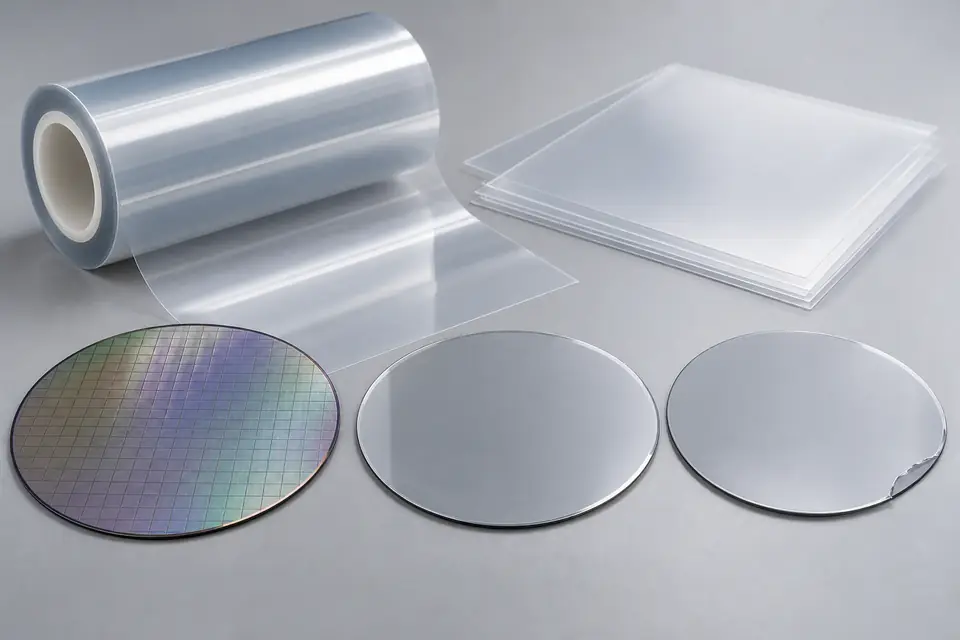
Temporary Wafer-Bonding Film is processed by rotary die cutting to support wafer-level packaging, underfill, thermal management and substrate handling. The finished geometry must remain compatible with downstream handling and assembly.
Cut-quality control
Production teams compare accepted and rejected samples for profile dimensions, edge integrity, coating continuity, particle level, flatness and release behavior, then relate the result to repeat pitch, anvil condition, cutting pressure, registration and matrix path.
Stable material and waste handling
cleanroom-compatible support, low-distortion feeding and protected finished-part transfer help the product and waste leave the cut zone consistently without creating a second defect after separation.
Formas habituales de describir este problema de corte
- temporary wafer-bonding film rotary die-cutting blades cuchillas de corte 1
- industrial temporary wafer-bonding film rotary die-cutting blades cuchillas de corte 2
- custom temporary wafer-bonding film blades for rotary die cutting cuchillas de corte 3
- how to improve rotary die cutting of temporary wafer-bonding film cuchillas de corte 4
- temporary wafer-bonding film rotary die cutting edge defect analysis cuchillas de corte 5
- temporary wafer-bonding film rotary die cutting dimensional control cuchillas de corte 6
- Advanced semiconductor packaging temporary wafer-bonding film rotary die cutting setup cuchillas de corte 7
- temporary wafer-bonding film blade RFQ data for rotary die cutting cuchillas de corte 8
Defina el resultado de corte requerido
- Achieve registered parts and stable waste-matrix separation for temporary wafer-bonding film
- Prevent layer lift, edge contamination, wrinkling, adhesive stringing or dimensional drift
- Maintain the required geometry for wafer-level packaging, underfill, thermal management and substrate handling
- Deliver a cut condition accepted by the next advanced semiconductor packaging operation
Problemas que deben diagnosticarse antes de cambiar la cuchilla
The cut edge shows layer lift, edge contamination, wrinkling, adhesive stringing or dimensional drift
Compare blade condition, repeat pitch, anvil condition, cutting pressure, registration and matrix path, material lot and accepted versus rejected samples.
Finished dimensions drift during a production run
Check feed registration, tension or hold-down, temperature, support condition, runout and when dimensions are measured.
The workpiece shifts, curls or loses functional surface quality
Review cleanroom-compatible support, low-distortion feeding and protected finished-part transfer, contact-face cleanliness, material direction, support and the first point where deformation appears.
Product and waste do not separate consistently
Check cut completeness, waste width, exit angle, static, extraction, collection tension and downstream transfer.
Tipos de cuchilla que pueden considerarse
| Posible tipo de cuchilla | Cuándo puede considerarse | Qué debe confirmarse |
|---|---|---|
| Rotary die-cutting blade | Considered when rotary die cutting requires registered parts and stable waste-matrix separation under stable support and guidance. | Confirm only after reviewing a real temporary wafer-bonding film sample, the equipment interface, mounting drawing, operating direction and an accepted cut reference. |
| Magnetic-cylinder flexible die | Considered when the equipment interface and material response require an alternative geometry or cutting motion. | Confirm only after reviewing a real temporary wafer-bonding film sample, the equipment interface, mounting drawing, operating direction and an accepted cut reference. |
Información necesaria para la revisión técnica
No necesita conocer el nombre exacto de la cuchilla. Envíe la información disponible sobre la pieza, la máquina, la cuchilla actual y el resultado de corte requerido para evaluar la aplicación a partir de un plano o una muestra.
- Temporary Wafer-Bonding Film composition, grade, thickness and allowable lot variation
- Layer, coating, porosity, temper, adhesive or surface-function details relevant to rotary die cutting
- Input width and target dimensions, tolerances and acceptance drawing
- Line speed, feed mode, tension or hold-down, temperature and cutting frequency
- Current blade or knife drawing, holder interface, mounting dimensions and used sample
- Material direction, support, contact faces and product or waste collection method
- Accepted and rejected samples with limits for profile dimensions, edge integrity, coating continuity, particle level, flatness and release behavior
- Trial quantity, inspection method, downstream operation, packing and annual demand
Preguntas sobre esta aplicación de corte
Why must temporary wafer-bonding film be reviewed as a complete material construction?
Its substrate, coating, interfaces and surface condition can respond differently to pressure, friction and bending, so nominal thickness alone does not predict rotary die cutting performance.
Can the blade be selected from the material name alone?
No. Confirm repeat pitch, anvil condition, cutting pressure, registration and matrix path, the holder interface, production speed, support and accepted samples before fixing the blade geometry.
What commonly causes defects during rotary die cutting?
Material variation, unstable support, alignment error, contamination, inappropriate clearance and blade wear can interact to create layer lift, edge contamination, wrinkling, adhesive stringing or dimensional drift.
When should the finished dimensions be measured?
Record both immediate and conditioned results when recovery, residual stress, temperature, moisture or adhesive flow can change the part after cutting.
What should be recorded during a production trial?
Record the temporary wafer-bonding film lot, setup, speed, support, blade condition, dimensions, edge observations, waste behavior and downstream acceptance.
Información relacionada sobre productos y servicios
- fan-out wafer-level packaging film: rotary die cutting cuchillas de corte - fan-out wafer-level packaging film · rotary die cutting
- semiconductor underfill adhesive film: rotary die cutting cuchillas de corte - semiconductor underfill adhesive film · rotary die cutting
- chip heat-spreader graphite foil: rotary die cutting cuchillas de corte - chip heat-spreader graphite foil · rotary die cutting
Solicite una revisión de su cuchilla de corte a medida
Envíe los datos de la pieza, la máquina o el portacuchillas, fotografías o una muestra de la cuchilla actual, la cantidad requerida y ejemplos del problema de corte. Las dimensiones finales, el material, la geometría del filo y las tolerancias se confirman según los requisitos aprobados.
Información relacionada sobre productos y servicios